



Feature Article
- Home
- Feature Article
- Is Fear of Mt. Fuji’s Eruption Justified? Your Questions Answered — and the Hidden Wonders of the Yamanashi Prefectural Mt. Fuji Research Institute, Where All Five Senses Learn

Is Fear of Mt. Fuji's Eruption Justified? Your Questions Answered —
and the Hidden Wonders of the Yamanashi Prefectural Mt. Fuji Research Institute, Where All Five Senses Learn
Mt. Fuji — Japan's highest peak, admired from afar for its beauty and experienced with awe up close. But how often do we think about its other face: an active volcano still quietly building energy beneath that beautiful surface?
We spoke with Mitsuhiro Yoshimoto of the Yamanashi Prefecture Mount Fuji Research Institute — a leading volcano specialist and disaster prevention expert. In this interview, he explains what could happen if Mount Fuji erupts, how volcano disaster preparedness differs completely from earthquake response, and the institute's lesser-known outreach programs that warmly welcome visits from the general public and even children.
Let's peek into the exciting, everyday world of Mt. Fuji research!
-
Point 1
Is Mt. Fuji Still Only 10 Years Old!?
Understanding Volcanoes and Their Gifts Through the "Cola" Analogy -
Point 2
This Is Where It Differs from Earthquakes!
The Reality of "Informed Fear" Disaster Preparedness on Mt. Fuji -
Point 3
From Hands-On Teaching Materials to a Free Weekend Exhibition Hall!
Get Connected with Your Community — Visit the Accessible Yamanashi Prefectural Mt. Fuji Research Institute -
Column
6 Meters Thick Up Close, 2 Centimeters in Tokyo?
Don't Miss the Handmade "Volcanic Ash Peel Sample"! - More Related Links & Video Introductions
POINT 01
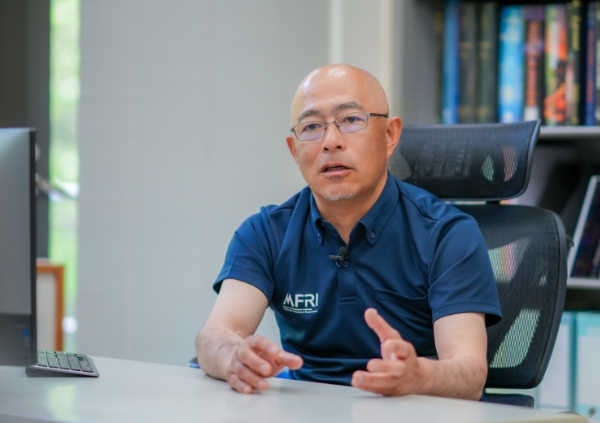
Is Mt. Fuji Still Only 10 Years Old!?
Understanding Volcanoes and Their Gifts
Through the "Cola" Analogy
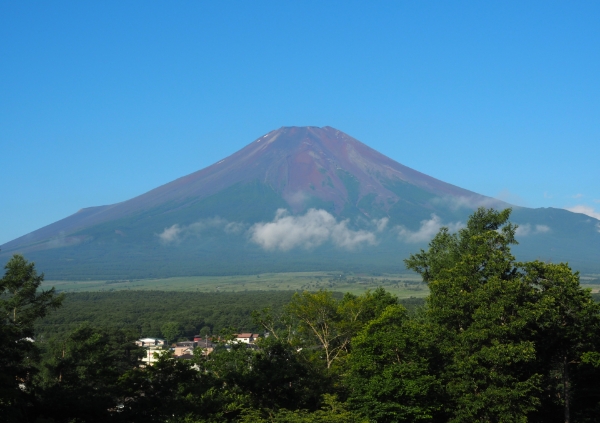
The last time Mt. Fuji erupted was approximately 300 years ago, in the "Hōei Eruption." Because it has been silent for so long, many assume it will never erupt again — but Mr. Yoshimoto offered a unique lifecycle analogy to put it in perspective.
"A volcano's lifespan is about one million years. Mt. Fuji is only 100,000 years old — the equivalent of a 10-year-old child in human terms. When you think of it that way, 300 years without an eruption is really just Mt. Fuji holding its breath for a moment."
Mr. Yoshimoto also uses a cola analogy to explain how such different materials — "flowing lava" and "falling volcanic ash and pumice" — can come from the same magma.
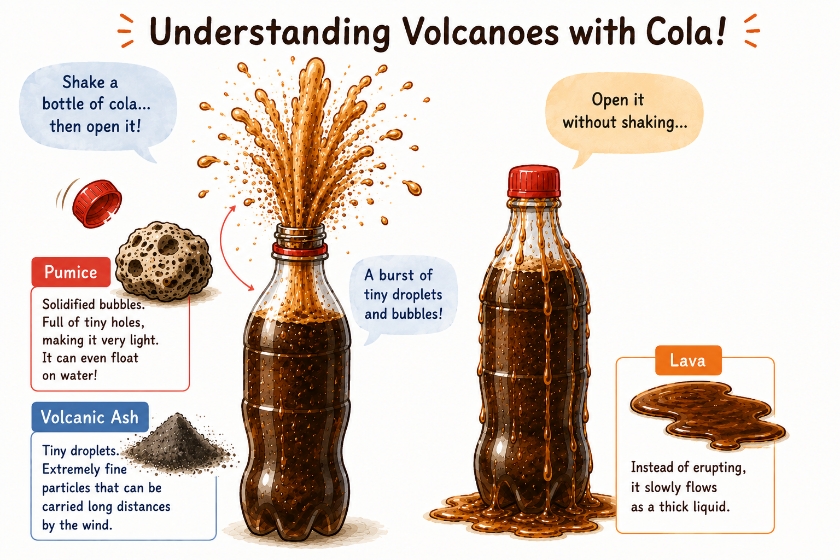
"When you shake a cola and open the cap, the foam bursts out forcefully. That foam, when solidified, becomes pumice — and the fine droplets become volcanic ash. Conversely, unshaken cola flows out slowly without exploding. That's lava."
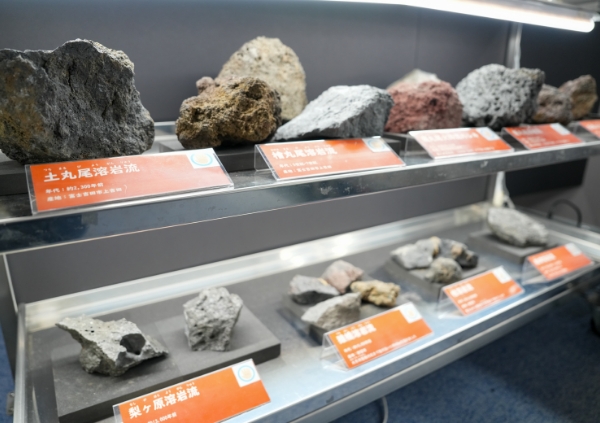
By studying geological layers, we can understand how Mt. Fuji grew over time. The beautiful foothill slopes we see today exist not only because of lava, but also because "lahar flows" (slash avalanches) — volcanic ash washed away by rain and snow — filled in the gaps. While volcanoes bring disaster, they are also the very source of the abundant spring water we benefit from and the stunning scenery we are lucky enough to see today.
POINT 02
This Is Where It Differs from Earthquakes!
The Reality of "Informed Fear" Disaster Preparedness on Mt. Fuji
Volcanic disaster preparedness is fundamentally different from earthquake preparedness, which deals with sudden, unpredictable events. While earthquake damage is primarily caused by shaking, volcanic eruptions produce lava flows, pyroclastic flows, mudflows, volcanic projectiles, volcanic gases, and more — according to the Cabinet Office, at least 16 separate hazard categories. Each of these hazards differs in temperature, speed (ranging from over 100 km/h to the pace of a walking human), and the distance they can reach.
Mt. Fuji adds another layer of complexity: eruptions can occur anywhere along a 28-kilometer span on both flanks, not just at the summit. This makes it impossible to simply copy the disaster preparedness plans of neighboring municipalities. Towns close to the mountain must prepare for projectiles and pyroclastic flows; towns farther away must think about lava flows and volcanic ash. Understanding which hazards apply to your specific location is essential.
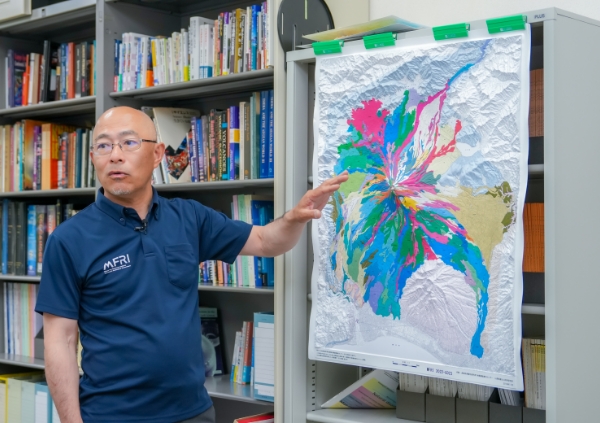
"That's precisely why it's important not to panic or flee all at once, but to understand and 'fear correctly,'" says Mr. Yoshimoto. Just as understanding how a virus works and how to protect yourself expanded people's options during the pandemic, knowing your specific hazards allows you to evacuate calmly and effectively.
Making a habit of staying informed through real-time data tools like "Imafuji" — checking what's happening on the mountain right now — is itself a meaningful disaster preparedness action.
POINT 03
From Hands-On Teaching Materials to a Free Weekend Exhibition Hall!
Get Connected with Your Community —
Visit the Accessible Yamanashi Prefectural Mt. Fuji Research Institute
The Yamanashi Prefectural Mt. Fuji Research Institute studies Mt. Fuji's volcanic activity and natural environment day and night. While "research institute" might conjure images of a closed-off, strictly academic facility, it is in fact deeply committed to public outreach and education — helping local residents and children feel a personal connection to Mt. Fuji.
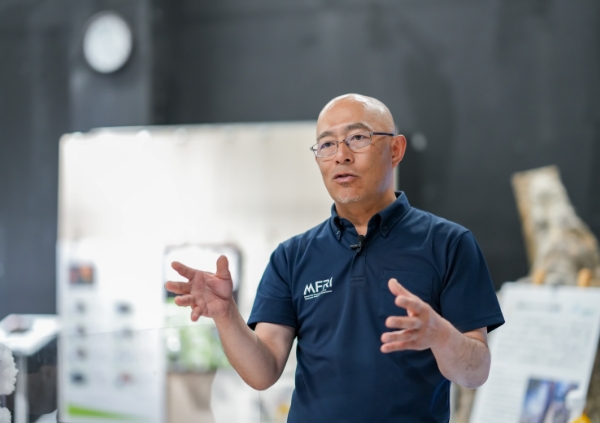
Mr. Yoshimoto's passion for children's education stems from a personal experience. "When I was in elementary school, a teacher was always in the science room — no matter what question I had, they always gave me a hint or an answer. That made learning fun and sparked my love of science. I want today's children to experience that same joy of having an adult nearby who can answer their questions."
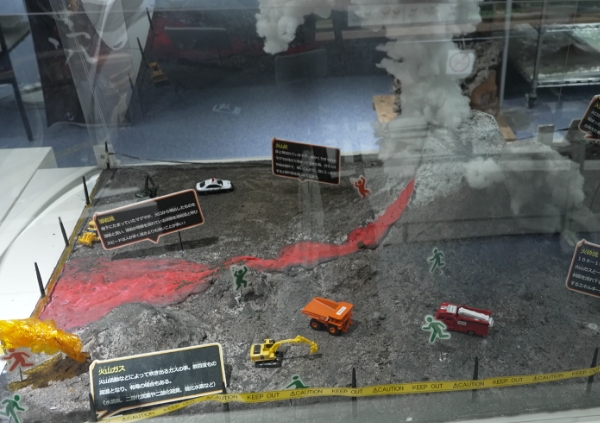
As a result, the institute actively hosts field trips, volcanic lectures, and hands-on experiment classes for local elementary school students. One standout example is their original "experiment kit" for 6th-grade elementary and 1st-year junior high students studying volcanology. Using 3D topographic models, students are asked: "Lava flows downward, just like water — so if it erupted here, where would it flow?" and then pour liquids themselves to find out. Teachers report that students love it because "they can think through it and understand it themselves."
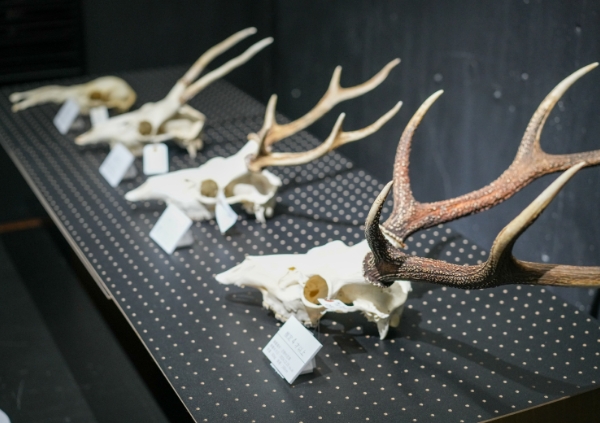
And perhaps most surprisingly — it's not widely known that the Yamanashi Prefectural Mt. Fuji Research Institute is open to the general public free of charge, including on weekends. Inside, you'll find an abundance of handcrafted displays painstakingly created by resident researchers specializing in birds, deer, volcanology, and more — working together with the education staff.
"I don't just want people to look — I want them to drop by casually, see and touch things in person, and feel what Mt. Fuji is really like. It would make me so happy if that made them fall in love with Mt. Fuji even more," says Mr. Yoshimoto. Come experience up close how real researchers keep watch over Mt. Fuji — this hidden "wonderland of knowledge" in the Fuji area is waiting for you.
ColumnPro Tips Column: Must-See Highlights for Getting 100% Out of the Research Institute
-
1 Must-See! The Handmade "Volcanic Ash Peel Sample"
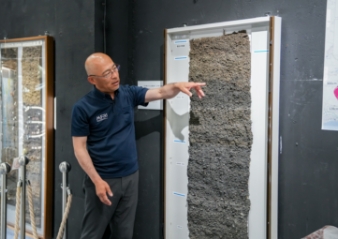
The exhibition hall's star attraction is an authentic specimen of volcanic ash from the Hōei Eruption 300 years ago, physically peeled from actual geological strata.
The display makes immediately clear how ash that was 6 meters thick at a point 6 km from the crater thinned to 2 meters at 14 km, and just 2 centimeters in Tokyo — shrinking in particle size and depth as you move farther away. It was crafted by researchers and education staff themselves, so that even people far from the volcano can viscerally grasp what a volcanic eruption really means.
-
2 A Mt. Fuji-Specialized Library Is Also On-Site!
The institute houses a library with books on Mt. Fuji's flora and fauna, specialized research on birds and deer, history, and more — all free to use, including on weekends (book lending for local residents available). The surrounding area features nature trails for enjoying the outdoors, and guided tours are also available.
MoreRelated Links
Yamanashi Prefectural Mt. Fuji Research Institute — Official Website
[URL:https://www.mfri.pref.yamanashi.jp/]
(Find information on the exhibition hall, children's events, and nature trail guided tours here!)
YouTube Short Videos
We've released short videos featuring Mr. Yoshimoto's mini-message on "informed fear" disaster preparedness, condensed into 1 minute!
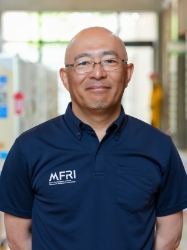
Mitsuhiro Yoshimoto
- Head of Research Division, Yamanashi Prefectural Mt. Fuji Research Institute (Research Director)
- PhD (Science)
- Volcanology, Volcanic Disaster Prevention
PROFILE
Specializes in volcanology and volcanic disaster prevention. Conducts research investigating the history and eruptive processes of Mt. Fuji through survey and analysis of past eruption deposits. Also involved in developing concrete disaster preparedness measures, including hazard maps and eruption scenario planning, based on the scientific data obtained. Currently leading the Cabinet Office research project "Development of Mt. Fuji Disaster Prevention Learning Curriculum (FY2025–2027)." As a volcanology expert, is involved in building disaster preparedness frameworks in collaboration with government agencies and local communities, while actively conducting outreach lectures to educate the next generation. Served as volcanic consultant (supervisor) for the NHK Special program "Mt. Fuji's Great Eruption: The Approaching 'Grey Nightmare.'" Also serves as a volcanology expert on the volcanic disaster prevention councils for both Mt. Fuji and Mt. Hokkaido-Komagatake. Continues to widely communicate the importance of Mt. Fuji volcanic disaster preparedness through media appearances and lectures across Japan.